


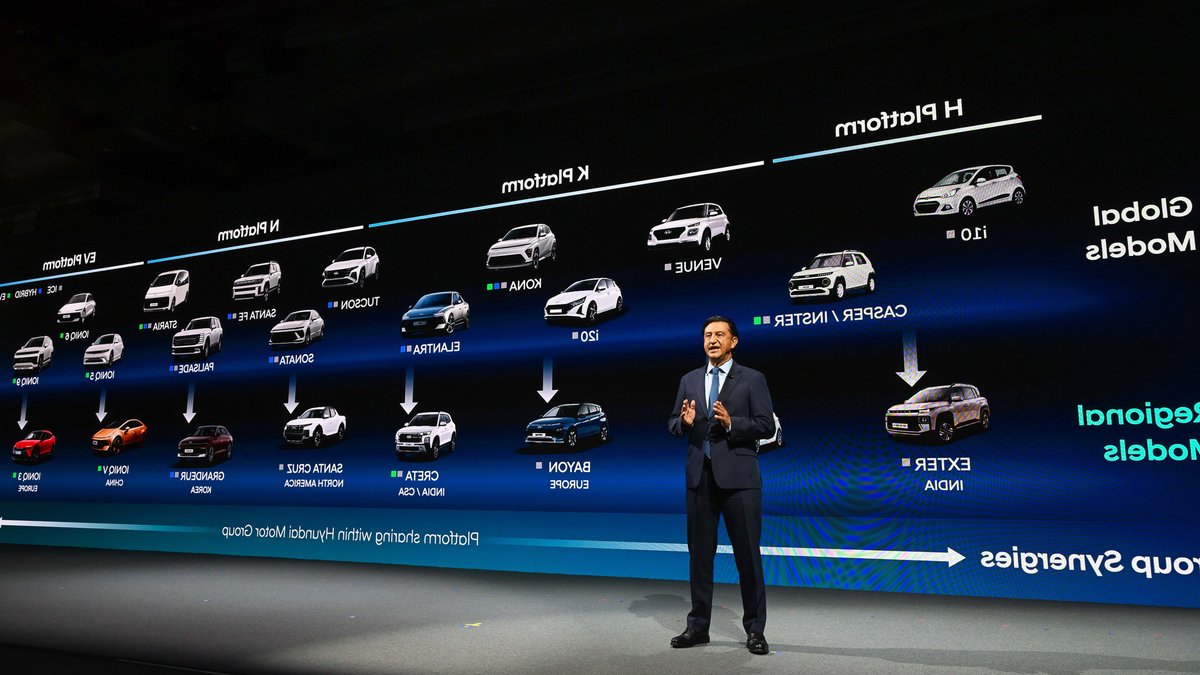
Hyundai Motor Company is ramping up its product offensive, with plans to launch or refresh over 100 vehicles globally by 2030. The Korean automaker, led by President and CEO José Muñoz, aims to reach 5.55 million annual sales and boost profitability with this aggressive strategy.
Global Product Lineup
Hyundai will introduce 58 new or refreshed models in North America, 49 in Korea, 41 in Europe, 26 in India, and 22 in China. Many of these will be all-new products or entries into new market segments.
Some key upcoming models include the all-new Elantra, IONIQ 3, Tucson, and Tucson Hybrid, along with the first-ever Santa Fe equipped with an extended-range electric vehicle (EREV) powertrain. A new global B-segment SUV, a European B-segment SUV, and an A-segment electric SUV for India are also in the pipeline.
Upcoming Launches
The all-new Tucson and Tucson Hybrid are set to launch in initial markets in the fourth quarter of 2026. The IONIQ 3, already on sale in Europe, offers up to 497 kilometers of range and features the new Pleos Connect infotainment platform. The Santa Fe EREV, with an expected range of over 965 kilometers, is scheduled for the first half of 2027.
Hyundai will also expand into segments where it currently has limited representation, such as body-on-frame vehicles, midsize pickup trucks, and light commercial vehicles. The high-performance N division targets 100,000 annual sales by 2030.
Related: Jewelry Pairing Tips: What to Wear with Your Sapphire Ring
Supporting this product expansion, Hyundai plans to offer more than 10 hybrid models in North America and achieve 85% electrification in Europe by 2030. The company is also developing lower-cost EV batteries, improved battery management systems, and new safety technology.
Beyond Hyundai, the wider group’s plans include the Genesis GV90 flagship SUV, the brand’s first GV80 Hybrid, and an EREV SUV with a targeted range of over 640 miles. Genesis aims to expand to more than 40 markets and reach 350,000 annual sales by 2030.
Looking ahead, Hyundai also targets software-defined vehicles, autonomous driving, robotaxis, and robotics as future growth areas. IONIQ 5 robotaxis developed with Waymo are scheduled for delivery in the fourth quarter, with Hyundai’s autonomous-driving technology expected to reach Level 2+ capability in a mass-produced SDV by 2028.
With over 100 launches and refreshes planned, Hyundai seeks to capture new segments and respond to changing consumer demand for electrification. However, the success of these ambitious plans may hinge on factors such as market acceptance, technological advancements, and global economic conditions.

